

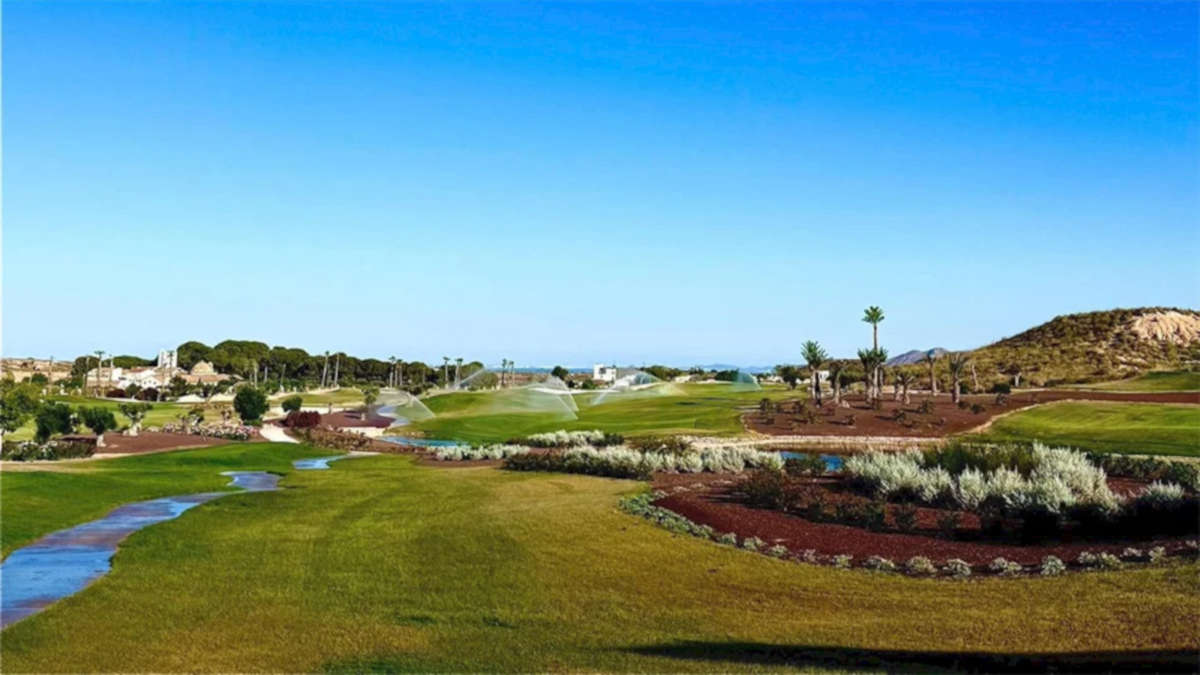
Club de Golf La Peraleja in Murcia, Spain, will reopen nine holes of its 18-hole course in late-September 2026 following a redesign by Magnolia Golf Design. The remaining nine holes are scheduled to reopen in September 2027.
The course originally opened in 2007 and was created by Magnolia’s Gonzalo and Antonio Lavín in collaboration with Seve Ballesteros. Following the club's closure in 2017 and a subsequent change in ownership, Magnolia was appointed in February 2025 to develop a redesign plan.
The redesign shifts the course to a "desert style" layout to reduce water consumption, replacing the previous "wall-to-wall" irrigation approach.
“The goal was to preserve the original course philosophy and strategic layout, while introducing a new design style,” said Gonzalo Lavín. “We have also transformed La Peraleja into a ‘desert style’ layout to reduce water consumption, as it was previously irrigated ‘wall-to-wall’.”
Through optimized irrigation, the club aims to lower annual water use from 256,000 cubic metres to 192,000 cubic metres.
“The most significant savings in irrigating surfaces will be between tees and the start of fairways, as well as the outer lateral edges adjacent to the course boundaries,” said Lavín.
Earthworks began in April 2025 with the original 2007 construction contractor. Head greenkeeper Antonio González Aragón and contractor CESPIAsport are also involved in the renovation.
Initial work required clearing brush and vegetation, alongside inspecting infrastructure including green, bunker, and fairway drainage, lake liners, and irrigation equipment.
“The first task was to clear the golf course, which was overgrown with brush and vegetation,” said Lavín. “To respect Seve’s design philosophy, which was based on naturalness, variety and the adaptability of the course to the terrain’s geomorphology, we had to adapt the design to suit the current conditions, which is why it was essential to implement an irrigation system aligned with current water availability. After shaping playing surfaces, we reviewed them to ensure that the original design is preserved, especially on the greens, where slopes and contours must be measured down to the centimetre. The goal is to maintain the integrity of the original design.”
A 10-centimetre sandcap was added across the site, combined with hydro-absorbent polymers and peat. On the greens, the new sand layer was placed over the original sand to restore a 30-centimetre depth. Newly designed tees received 15 centimetres of sand, while existing tees received 10 centimetres.
Drought-resistant turfgrass species supplied by Semillas Dalmau were selected for the playing surfaces.
“For greens we have selected to use 777 creeping bentgrass, while on tees, fairways, approaches and semi-rough we will use bermuda,” said Lavín. “These species have a resilience to heavy foot and cart traffic, and are adaptable to the various areas of the course.”
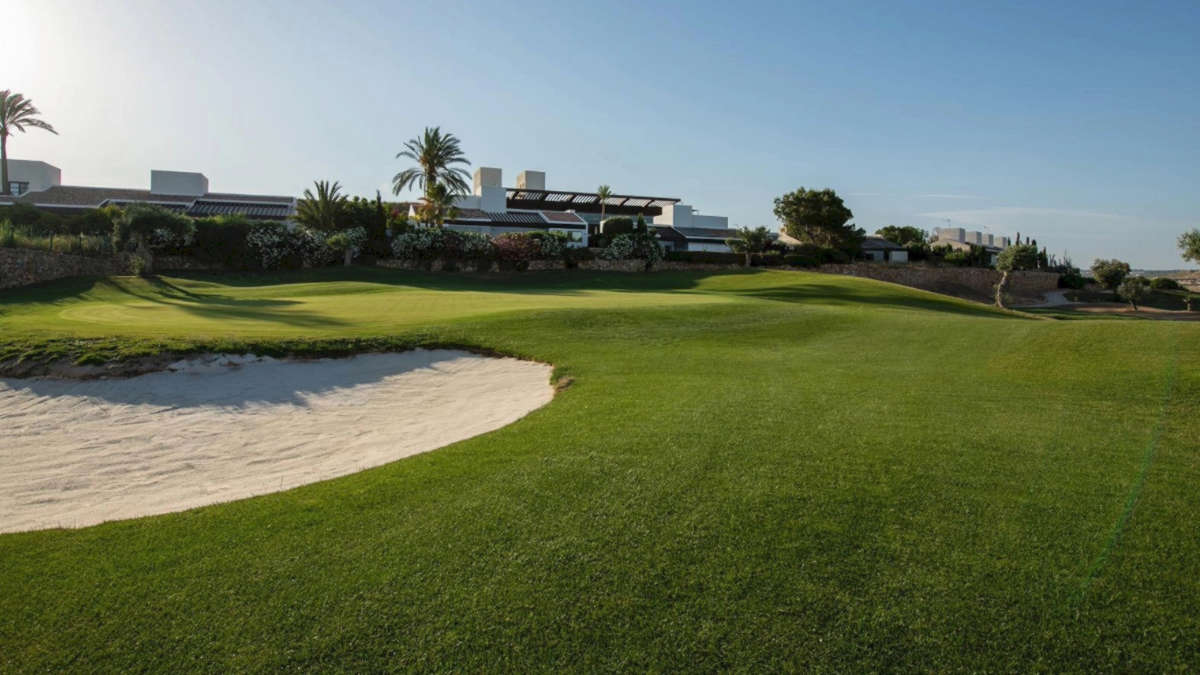
For the course's non-irrigated desert areas, Magnolia applied albero sand, supplied by Cimasa, combined with semi-desert plants and trees along the course's perimeter.
“Albero sand is a widely used and recommended mixture for non-irrigated zones in golf courses and other Mediterranean landscape environments due to its specific characteristics: durability, low water retention and aesthetic appeal,” said Lavín. “It has a light yellow or beige colour and a sandy-limestone texture, making it well-suited for these dry zones.”
Regarding the function of these zones, Lavín added: “Unlike bunkers, these waste areas do not require the same level of preparation or intensive maintenance. These zones, still, must be carefully designed to integrate aesthetically and functionally with the rest of the course.”
“The waste areas act as a buffer between the grassed playing surfaces and the out-of-bounds limits of the golf course. In many sections beyond the out-of-bounds line lie villas, apartments or other types of buildings. For this reason, it is important to give these areas landscape value, as they function like gardens for the adjacent homes.”
Following the late-September 2026 opening of the first nine holes, players purchasing a nine-hole green fee will be permitted to play the loop twice at no extra charge to complete an 18-hole round until the second nine opens in September 2027.