

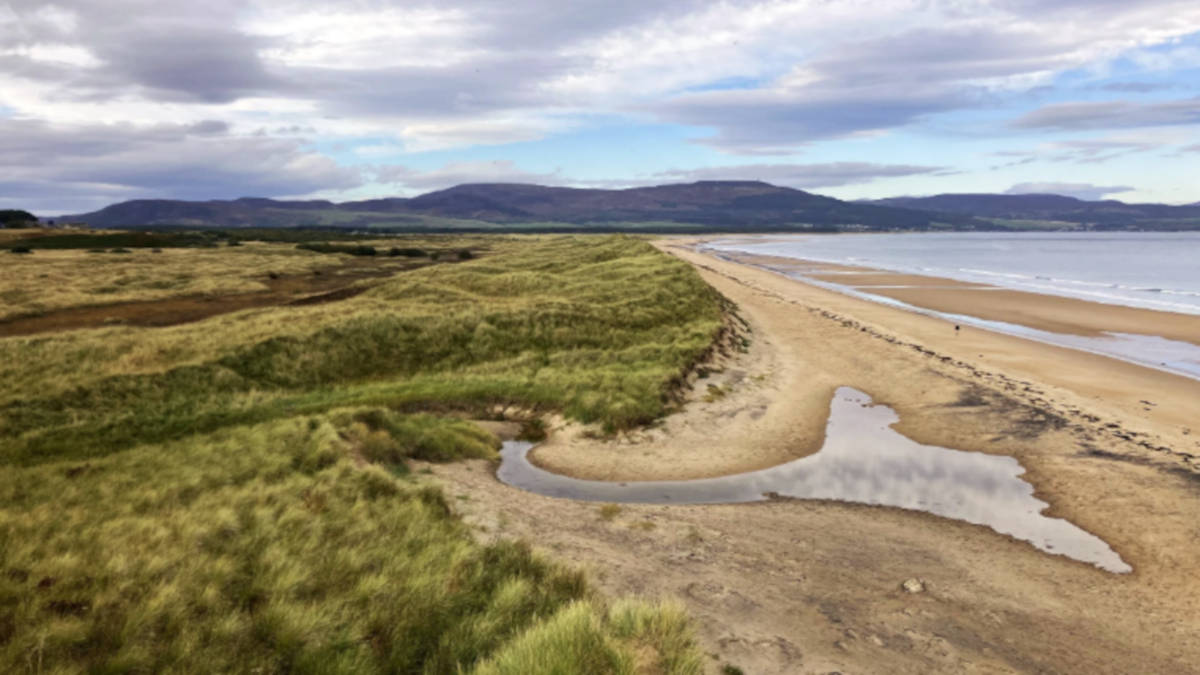
Plans to construct a highly controversial golf course on a protected Highland dune system have been officially rejected by Scottish Government planners, ending a long-running battle between local developers, environmental groups, and government Ministers over the ecological value of the coastal landscape.
The proposed development at Coul Links, located near Embo, just north of Dornoch in Sutherland, sought to build an 18-hole championship course alongside practice areas and associated infrastructure. However, Scottish Government planners concluded in a newly released report that the project would cause “significant harm” to an internationally vital natural environment.
Coul Links holds a triple-protected status, forming an integral part of the Loch Fleet Site of Special Scientific Interest (SSSI), the Dornoch Firth and Loch Fleet Special Protection Area (SPA), and the Dornoch Firth and Loch Fleet Ramsar site—a designation under the 1971 International Convention on Wetlands.
In their damning assessment, Scottish Government planners emphasized the irreplaceable nature of the location. "The Coul Links dune system is, even by the standards of an SSSI, of exceptional importance, with a range and quality of habitat types that may be unparalleled within Scotland," the report noted.
Addressing potential mitigation measures put forward by the developers, the planners remained unmoved: "Even under the most pessimistic position on the site's likely future deterioration and the most optimistic position on both the effectiveness of the proposed management commitments and the Applicant's ability to mitigate development impacts, the net effect on Coul Links would still be significantly adverse."
The decision overturns a controversial ruling by Highland Council’s planning committee, which had approved the application in 2024 despite receiving nearly 750 objections, opposing advice from its own officials, and formal warnings from NatureScot. That approval sparked immediate outrage among conservationists, prompting urgent demands for Scottish Ministers to intervene and call in the application to safeguard the land.
The project was spearheaded by Communities 4 Coul (C4C), a local grassroots community development group. C4C argued that the course would deliver a massive boost to the fragile regional economy, estimating that the development would generate between £8 million and £12 million annually while creating between 270 and 400 full-time jobs for East Sutherland—an area currently struggling with a declining working-age population. Furthermore, C4C maintained that their management plan offered a guaranteed, sustainable path to restore and protect a coastal landscape they claimed was currently neglected.
However, government report findings ultimately placed ecological preservation above economic speculation. Planners concluded that while local economic arguments were noted, "those benefits are not of national importance and do not clearly outweigh the significant adverse effects identified in relation to nationally important natural heritage interests."
The refusal has drawn widespread relief and praise from environmental charities and political leaders who fought against the plans.
Brendan Paddy, Director of Ramblers Scotland, welcomed the decision, citing severe impacts on recreational access and the natural landscape. "We are pleased and hugely relieved that the Scottish Government has turned down this damaging and inappropriate application at one of the east coast's last undeveloped dune systems," Paddy said. He noted that up to seven holes would have crossed the John o' Groats Trail, severely compromising walkers' access and ruining the natural dune environment forever. "I'd like to thank Ministers for showing that Scotland's finest landscapes and walking routes aren't simply up for sale to the highest bidder."
Scottish Greens MSP Ariane Burgess, who previously spearheaded a 4,500-signature petition demanding a review of the application, called the outcome "an important win for Scotland's wildlife and nature."
"Coul Links is an exceptionally important place for nature, with a unique range of habitats and wildlife found nowhere else in Scotland," Burgess stated. "Building a golf course on it would have been deeply damaging and completely at odds with Scotland's commitments to protect nature. We can't keep destroying our natural world in the name of profit."
RSPB Scotland Director Duncan Orr-Ewing echoed these sentiments, highlighting that this marked the second time in recent years that Ministers refused permission for a course on the site following a public inquiry, with similar plans having been rejected in 2020. "We hope developers will now realise that this type of damaging proposal, that goes against planning policy and harms protected sites, will not be accepted," Orr-Ewing said.
In contrast, Communities 4 Coul reacted with dismay to the decision. C4C Director Gordon Sutherland described the refusal as a "real blow" and a "slap in the face for local democracy."
"It will be hugely disappointing and dispiriting for all the many people in East Sutherland that have supported our proposals from the outset," Sutherland said. "Our plans offered a real opportunity to restore and sustainably protect the Coul Links site, while also creating lasting economic benefits... We do not envisage that this opportunity will present itself again."
Developers now have a six-week window during which they may choose to legally challenge the decision in court.